
Fillvisa is now Open Source!

Today, we’re taking an important step toward making immigration paperwork more accessible: Fillvisa is now open source.
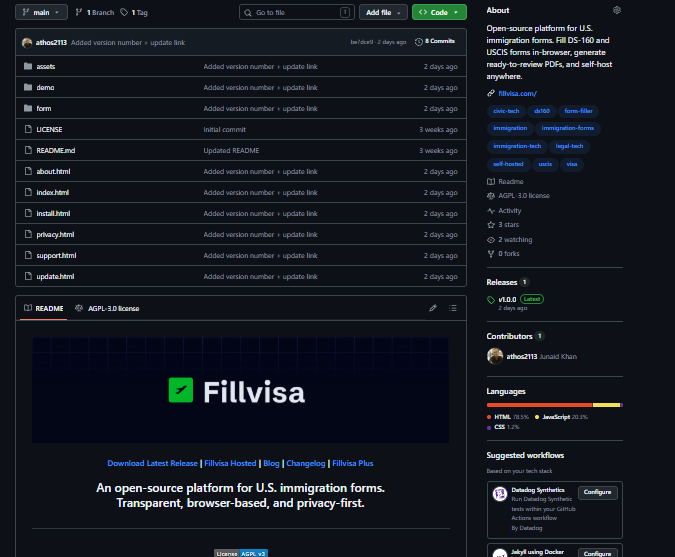
The source code for Fillvisa is publicly available on GitHub:
github.com/athos2113/fillvisa-os
Anyone can inspect the code, run Fillvisa themselves, share feedback, or build something entirely new on top of it.
For us, open sourcing Fillvisa isn’t just a technical decision. It fits directly into why we built Fillvisa in the first place.
What does “open source” mean?
Most software you use online is closed source. You can use the product, but you generally can’t see how it works behind the scenes.
Open-source software is different.
The underlying source code is publicly available. That means developers, organizations, and technically inclined users can inspect exactly what the software does.
With Fillvisa OS, you can:
- Review the code to understand how Fillvisa works.
- Self-host Fillvisa on your own infrastructure.
- Fork the project and modify it for your own needs.
- Build new tools on top of the existing form infrastructure.
- Share feedback
You don’t have to be a developer to use Fillvisa. Our hosted version at Fillvisa.com will continue to exist.
Open source simply gives users another option.
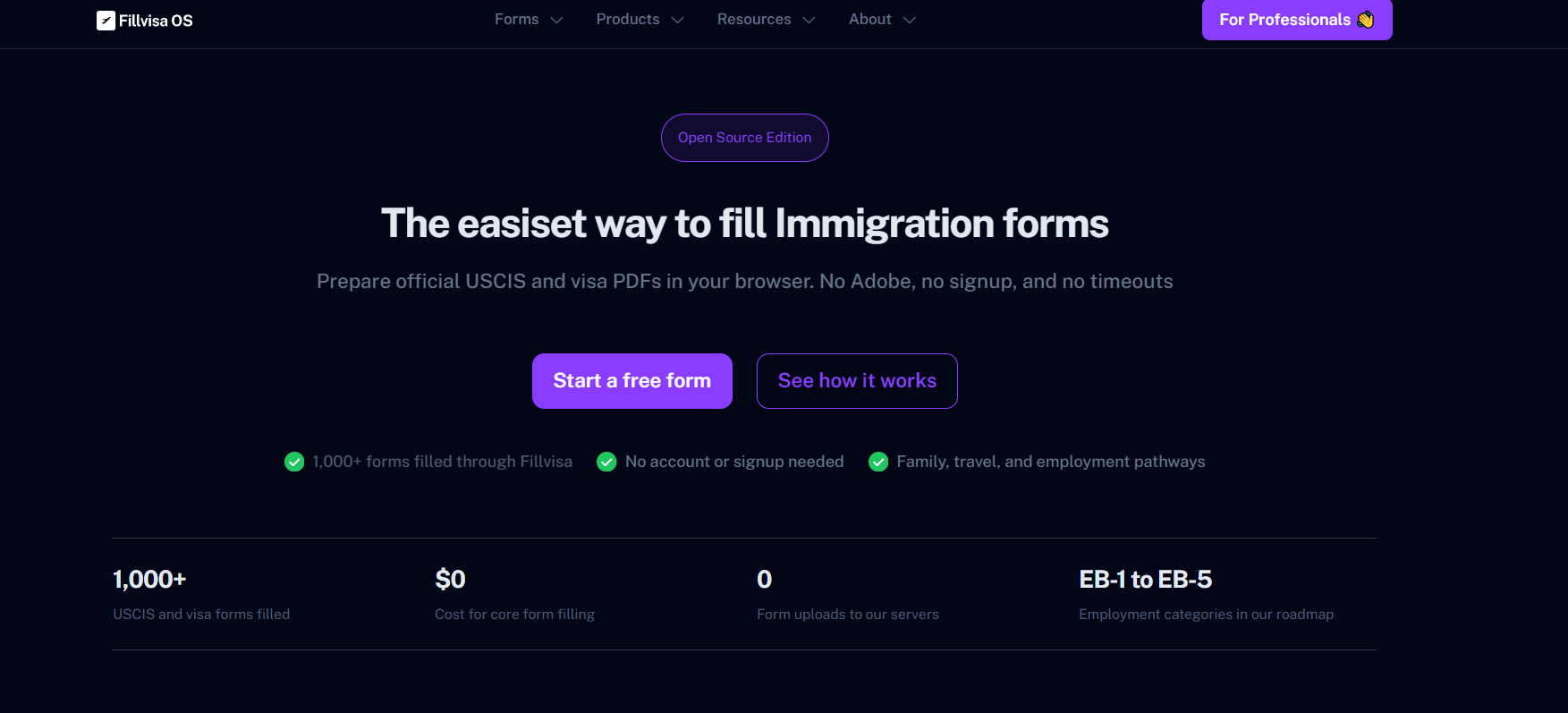
Why are we open sourcing Fillvisa?
There wasn’t one single reason. It was a combination of feedback from users and our broader vision for what Fillvisa could become.
1. Immigration software should be transparent
Immigration forms contain some of the most sensitive information people enter online.
Names. Addresses. Family information. Employment history. Immigration history. Financial information.
Over time, users asked us whether Fillvisa could be open source so that they could see exactly what was happening with their information. With Fillvisa OS, the code is there for anyone to inspect. You don’t have to simply trust what we say the software does. Developers and security-conscious users can verify it themselves.
For software dealing with immigration paperwork, we think that level of transparency is valuable.
2. You can self-host Fillvisa
Not everyone wants to use a hosted service.
An immigration nonprofit, community organization, developer, or technically sophisticated user might prefer to run the software themselves. Now they can.
Organizations can deploy their own instance of Fillvisa on infrastructure they control and adapt it to their environment. That can be particularly useful for organizations that have specific privacy, deployment, customization, or internal IT requirements.
3. Developers can build on top of Fillvisa
We’ve already spent a significant amount of time turning complicated government forms into easier, structured web experiences. Instead of every developer starting from zero, they can now build on top of that work.
A developer could fork Fillvisa and experiment with:
- New immigration forms
- Additional countries
- Different user interfaces
- Accessibility improvements
- Translation and localization
- Workflow automation
- Integrations with other immigration tools
- Tools for nonprofits and community organizations
We’re especially excited about possibilities we haven’t thought of yet.
Open source turns Fillvisa from just a product into infrastructure other people can build upon.
4. We want more feedback
Building immigration software is difficult. Government forms change. Instructions can be confusing. Different applicants encounter different edge cases. Making the project public gives us another way to improve it.
Developers can open issues. Users can report problems. Contributors can suggest changes. Organizations can tell us what is missing from their workflows.
The more people who look at the project, use it, and challenge our assumptions, the better Fillvisa can become.
5. It complements our goal: make immigration more accessible
Our goal with Fillvisa has always been straightforward:
Make immigration paperwork easier and more accessible.
Open source expands what “accessible” can mean. It means individuals can continue using the free hosted version. It means developers can inspect and modify the software. It means organizations can self-host it. And it means the work we’re doing doesn’t have to remain confined to a single website or company.
If someone can take Fillvisa, adapt it, and use it to help a community we would never have reached ourselves, that’s a win.
Fillvisa OS is licensed under AGPL-3.0
Fillvisa OS is released under the GNU Affero General Public License v3.0 (AGPL-3.0).
The AGPL is an open-source license designed to keep software - and improvements to that software - open.
In simple terms, you’re free to use, study, modify, fork, and deploy Fillvisa OS under the terms of the license.
One important characteristic of the AGPL is that if you modify the software and provide that modified version to users over a network, those users must also be given access to the corresponding source code under the AGPL.
That allows people and organizations to build on Fillvisa while helping ensure that improvements to the open-source project remain available to the broader community.
You can find the full license and source code in the GitHub repository.
So how does Fillvisa sustain the project?
Open source does not mean that there is no business behind Fillvisa. In fact, we think having a sustainable business around the project is important if we want to continue maintaining forms, fixing bugs, adding features, and investing in the ecosystem for years to come.
Our commercial products fund that work.
Fillvisa Plus
Fillvisa Plus is our professional product for immigration professionals, visa agencies, document preparers, and other organizations that need more than the free version.
It adds the infrastructure required to manage immigration work at scale - things like cloud storage, client collaboration, case management features, and professional tools.
Individuals can use Fillvisa for free.
Organizations that need a more complete workflow can use Fillvisa Plus.
Fillvisa White Label
Fillvisa White Label is designed for organizations that want their own branded immigration form platform.
It gives businesses and organizations a Fillvisa-powered platform under their own brand and domain, without requiring them to build the underlying form technology from scratch. Revenue from Fillvisa Plus and Fillvisa White Label helps us continue investing in the free and open-source ecosystem. We think this creates a healthy relationship between the two sides of Fillvisa:
Open infrastructure for everyone. Commercial tools for organizations that need more.
Where we go from here
We want Fillvisa to become increasingly useful not just as a website, but as an open platform for immigration forms.
There is a lot left to build.
More forms. Better documentation. Better accessibility. More languages. More integrations. And, hopefully, applications of Fillvisa that we haven't imagined yet.
If you’re a developer, immigration professional, nonprofit, civic-tech organization, or simply someone interested in making immigration easier, we’d love for you to take a look.
Explore Fillvisa OS on GitHub: github.com/athos2113/fillvisa-os
Star it. Fork it. Self-host it. Open an issue. Build on top of it.
And most importantly, tell us what we should improve next.
Immigration is complicated enough. The tools for navigating it shouldn’t have to be.